ServicesHardwood Flooring
Hardwood Flooring in Sugar Land, Laid for Years of Easy Care
A hardwood floor should get better with age, not start fighting you after the first humid summer. We choose the right construction for your subfloor, test for moisture before any boards arrive, and show you the simple habits that keep the wood stable and the finish intact.
Real Wood, Chosen for How Your Home Lives
Hardwood is the floor people keep for decades, which is exactly why the early decisions matter. Species, plank width, finish and whether the boards are solid or engineered all change how the floor wears, how it moves with the seasons and how much care it asks of you.
Most houses around Sugar Land sit on concrete slabs, and the Gulf Coast air carries a lot of moisture for much of the year. That points many first floors toward engineered hardwood, glued down or floated over a moisture barrier, while solid boards are often a good fit nailed over plywood upstairs. We explain the tradeoffs in plain terms so you pick the floor that suits the room, not the one with the biggest margin.
If wood is not the right answer for a wet area or a busy mudroom, we will say so and talk through options like Luxury Vinyl Plank or Tile Flooring instead.
What a Hardwood Installation Covers
Subfloor and moisture testing
We take moisture readings on the slab or plywood and check it for flatness before anything is ordered. A floor laid over a damp or uneven base is the most common reason hardwood cups, gaps or sounds hollow later.
Removal of the old floor
Carpet, pad, tack strip, laminate or old tile comes up and is hauled away. We scrape adhesive and fix high spots so the new boards sit flat.
Leveling and vapor protection
Low spots are filled and high spots ground down. On slabs we use the moisture barrier or adhesive system the flooring maker calls for, because it is what keeps ground moisture out of the wood.
Acclimation and layout
Boards rest in your home so they settle to indoor conditions. We plan the layout so seams are staggered, short pieces are kept out of sight lines and transitions to other rooms land cleanly.
Trim, transitions and expansion space
Wood needs room to move. We leave the right gap at the walls, hide it under baseboard or quarter round, and fit thresholds where hardwood meets tile or carpet.
A care walkthrough at the end
Before we leave, we go over cleaning products to use and avoid, felt pads, mats at doorways and the indoor humidity range that keeps the boards steady.
Signs It May Be Time for New Hardwood
Boards cupped or lifting
Edges that rise above the center of each board usually mean moisture got in from below. If the damage is widespread, replacing the floor over a properly protected base is the lasting fix.
Carpet that has worn out its welcome
Matted traffic lanes, stains that keep coming back and allergy concerns lead many people to hardwood. Wood holds less dust and cleans with a dry mop.
Soft spots or loud squeaks upstairs
A floor that flexes underfoot often points to loose or damaged subfloor. We address the base first so the new wood stays quiet.
Cracked or split planks across a room
A few damaged boards can sometimes be swapped out. When splits run through many rows, the floor has usually reached the end of its useful life.
Laminate or vinyl that is peeling
Worn wear layers and swollen seams are hard to repair well. Hardwood is a step toward a floor you can maintain rather than replace every few years.
How Your Hardwood Project Runs
- 1
Walkthrough and measurements
We visit, measure each room, take moisture readings and look at doorways, stairs and transitions. You get a written estimate broken out line by line.
- 2
Material choice and delivery
Once you settle on species, width and finish, the boards are delivered and left to acclimate. We tell you how many days that takes for the product you picked.
- 3
Preparation day
Old flooring comes out, the subfloor is cleaned and leveled, and openings to other rooms are covered to keep dust contained.
- 4
Installation
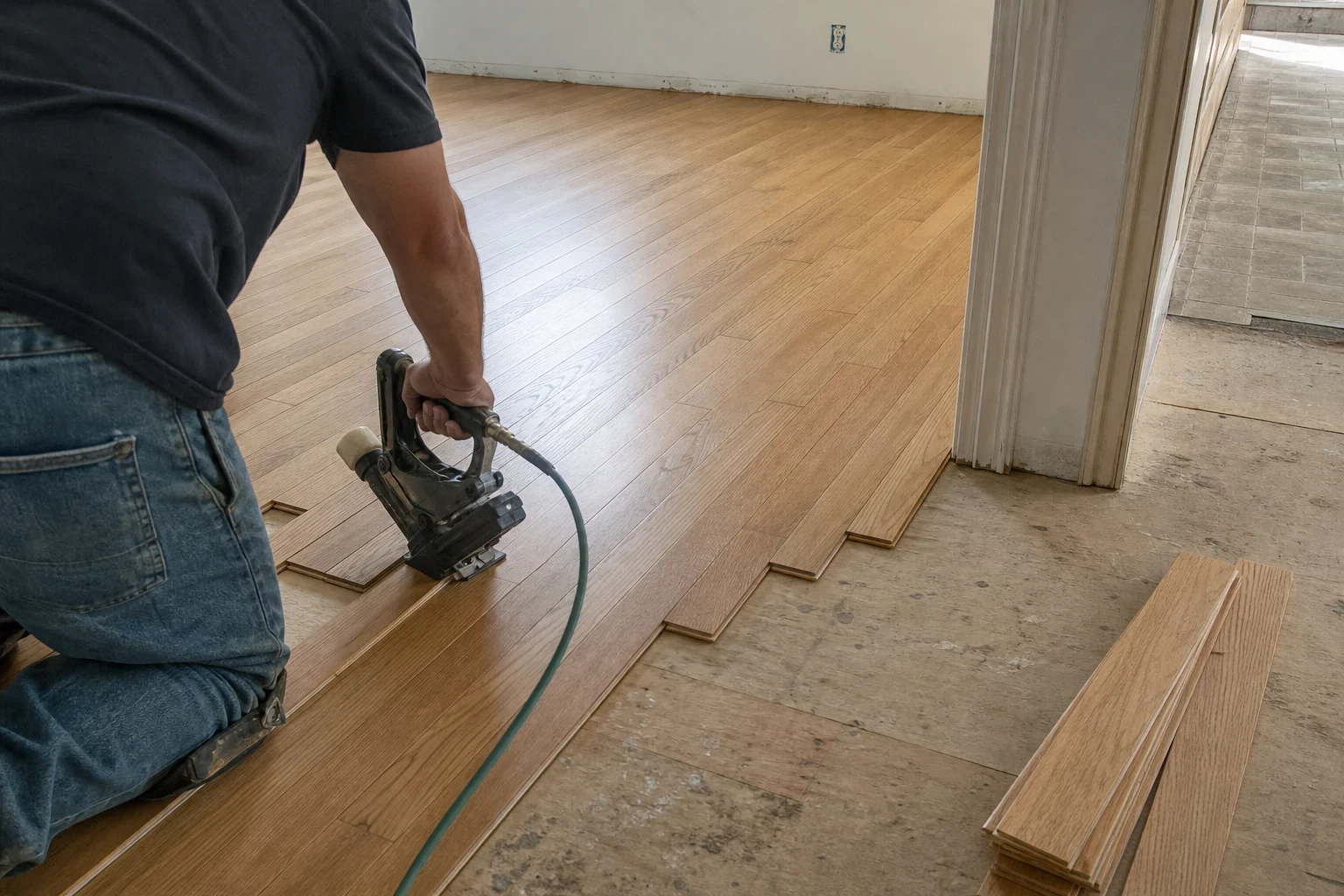
Boards go down by nailing, gluing or floating, depending on the product and the base. We check alignment row by row and fit trim and thresholds as we go.
- 5
Cleanup and care notes
We clean up, haul off debris and walk the floor with you. You leave with care instructions written for the exact product in your home.
What Shapes the Price of Hardwood
Hardwood pricing depends on the room as much as the wood. Two floors of the same size can differ a lot once prep work and layout are counted. Our written estimate shows each item so you can see where the money goes.
- Solid or engineered, and the species
- Oak, hickory and maple carry different material costs. Engineered boards with a thicker wear layer cost more up front but give the surface a longer usable life.
- Condition of the subfloor
- A flat, dry slab needs little work. Leveling, moisture mitigation or replacing damaged plywood adds labor and material.
- Removal and disposal
- Pulling up glued tile or old wood takes more time than lifting carpet, and that shows up in the estimate.
- Layout and room count
- Open rectangles go quickly. Angled walls, many doorways, closets and herringbone or diagonal patterns add cuts and waste.
- Stairs and transitions
- Treads, nosings and thresholds are priced separately. Our Stair Flooring page covers how we handle steps.
Hardwood Flooring Questions
Something not covered here? (346) 598-7443
Can hardwood go over a concrete slab?
Yes, usually as engineered hardwood glued down or floated over a moisture barrier. Solid hardwood is generally not recommended directly on a slab. We test the concrete first so the method matches the moisture we actually find.
Should I choose solid or engineered hardwood?
Engineered boards have a real wood top layer over a stable core, so they handle humidity swings and slabs well. Solid boards suit plywood subfloors and give a traditional feel. We help you decide based on where the floor is going and how the room is used.
How do I keep hardwood looking good in a humid climate?
Keep indoor humidity steady, ideally with your air conditioning running through the warm months and not shut off for long stretches. Wipe up spills quickly, use a damp, never wet, mop and skip steam cleaners. Felt pads under furniture and mats at exterior doors prevent most scratches.
Is hardwood a good choice with dogs?
It can be. Harder species, wire-brushed or hand-scraped textures and matte finishes hide scratches far better than glossy, soft woods. Keeping nails trimmed helps more than any product.
Can a few damaged boards be replaced instead of the whole floor?
Often, if matching boards are available and the damage is limited. We recommend keeping a box of leftover planks from your installation for exactly this reason. If moisture caused the damage, we look for the source first so the new boards do not fail the same way.
Start With a Floor You Can Keep
Tell us about the rooms, the subfloor and how your household uses the space. We will talk through wood options and set up a time to measure and test.